

We Need GameDay Programs More Than Ever
Somewhere an old vendor is smiling, because modern Baseball rosters are almost impossible to follow


“Programs here! Programs here! You can’t tell the players without a scorecard! Get your Program right here!”
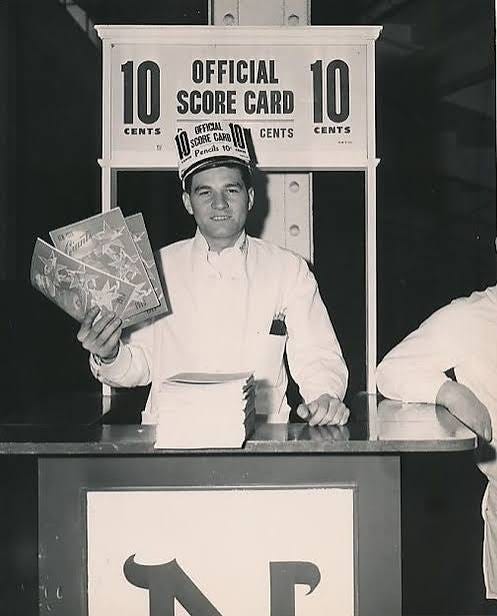
That was a common sound at a baseball game for decades. I heard it in Oakland and San Francisco. I heard it in movies and television programs. I’ve said it — in conversations, in print, and on the air. It’s fun to say.
Nowadays, you need a program more than ever to keep up with the endless transaction in baseball, yet most teams stopped selling programs because people stopped buying them.
The epidemic of injuries in Baseball boggles my mind.
We’ve never known more about strength training, recovery, diet, sleep and hydration. We’ve never had more devices and products to assist with all this. Yet we’ve never had more injuries.
Each day, when I get this daily boxscore recap, I start at the bottom to look at the transactions of players getting signed, reassigned, traded, optioned, outrighted, released and placed on various injured lists.
Here’s a recap of the last week:
Saturday — A slow day, a total of 30 transactions: 3 going on the Injured List, 5 starting rehab assignments (including Elly De La Cruz and Francisco Lindor), and 2 players getting designated for assignment. (More on DFA’s later.)
Friday — Not so slow, 42 total transactions: 2 going on the Injured List (including Mike Trout), 5 starting rehab assignments (including Hunter Greene), and 2 getting DFA’d.
Thursday — A busier day, 39 transactions: 4 on the Injured List (including Max Scherzer), 4 starting rehab assignments, and 2 were DFA’d.
Wednesday — The busiest day: 48 total transactions: 5 going on the Injured List (including Randy Arozarena as teammate Cal Raleigh came off), 10 (TEN!) starting a rehab assignment (including Brandon Woodruff), and 4 getting DFA’d.
Tuesday — Another busy day, 39 transactions: 4 on the Injured List (including Corey Seager), none started rehab assignments (!), and 3 were DFA’d.
Monday — The slowest day because most teams didn’t play, 22 transactions: 5 on the Injured List (including Jose Ramirez), 3 started rehab assignments, and 2 were DFA’d.
The six-day totals: 221 total transactions, 23 new players on various Injured Lists, 27 previously injured players starting minor league rehab assignments, and 15 players were DFA’d because of all the movement.
In 1988, when the Dodgers won the World Series, they used 19 pitchers all season (11 started). Each of the last two years, en route to World Series titles, the Dodgers used exactly 40 pitchers and 17 started once.
This year, the Dodgers already used 35 pitchers and it’s not the midway point. They have 11 pitchers alone on the Injured List — yet they still have the best record in the majors.


As the play-by-play broadcaster for a Triple-A team, I frequently hear “the gap between the Majors and Triple-A has never been higher” all the time.
It’s true.
The reason is injuries.
Everything in baseball comes back to injuries.
Every MLB team constantly needs a new player from the minors because of an injury. Whether the player is ready or not, someone gets called up. Sometimes to make room for that player on the 40-man roster, someone else gets designated for assignment, so two of the best Triple-A players come off a roster due to one injury.
A few weeks ago, my Albuquerque Isotopes lost their scheduled starting pitcher (called up) and cleanup hitter (DFA’d to make room on the 40-man) on the same day. A few weeks later, the Isotopes scheduled starting pitcher was scratched on consecutive days because he was needed in the majors.
I’m not picking on the Colorado Rockies. I just know them best because they are the affiliate of the Isotopes. Every team has a similar story that could be the example used.
Injuries lead to an endless cycle of transactions.
The injured player goes on a rehab assignment, gets reinstated from the Injured List, a player gets optioned back to the minors, but he might be out of minor league options. So he gets DFA’d. Or the now healthy player was on the 60-day Injured List and room is needed on the 40-man. That’s another DFA.
Sometimes the player clears waivers and returns to the minors, a few days later or a week later. Or he ends up with another team, another pitching coach or hitting coach, and an organization is not as invested in his future.
It’s an endless loop of roster maneuvering.
It’ll become more dizzying in the final two weeks of July before the trading deadline.
A few years ago, mlb.com started an ongoing link on the front page of every team’s website that keeps track of all injuries and transactions. It’s an open tab I keep on my laptop at all times, knowing I can just change “Rockies” to “Astros” or whatever team I need to research.
Another one of my favorite websites to try keeping track of Baseball transactions is thebaseballcube.com/newspaper, which lists all of the players on the Injured List at the bottom left.
As of Saturday morning, I counted 193 players currently on the Injured List. One hundred and ninety-three players are currently on the Injured List. Even that is deceptive because it does NOT count players who are on rehab assignments right now. So the number is well over 200. I’m not even sure where I can find the exact accurate number.
Five teams have 11 or more players on the Injured List right now. The Astros had 16 players on the Injured List, at the same time, in late April.
Before I continue, a pause for a reminder that I work in Baseball because I love Baseball and that’s why I worry about it so much.
For decades, baseball teams used a four-man starting rotation. Most starters pitched on three-days rest, started between 38-42 games, and pitched between 250-320 innings.
Then as injuries mounted, teams switched to a five-man rotation to limit those innings. The starters worked on four-days rest, started between 30-35 games, and pitched between 190-250 innings.
Then as injuries continued, teams started monitoring the quantity of pitches thrown. For awhile, the magic number seemed to be 120 pitches. Then it was 110. Now it’s 100.
Only two pitchers threw more than 100 pitches on Friday: Jacob deGrom (106 in 6 innings) and Jose Soriano (105 in 5 innings).
Every time hard-throwing superstar young phenoms Paul Skeenes and Jacob Misiorowski pitch, the collective fear around the sport is they are going to blow out their elbows and be the latest who need Tommy John elbow surgery.
Nobody in Baseball knows how to stop it. If they did, they’d be foolish to share information that provides such a competitive advantage.
More rest is not helping. Fewer pitches is not helping.
It’s not just pitchers. Hitters get hurt too.
They get injured by the ball and by the wall, by a slide and by a tag, in the weight room and during batting practice, hamstrings and quads, obliques and hips, shoulders and elbows and necks, and body parts I didn’t know existed before I worked in Baseball.
They even get injured when they are trying to avoid injuries, like when Carlos Correa suffered a rib fracture when getting his regular deep tissue massage.
When I was the A’s beat reporter for The Oakland Tribune in the mid-2000s, I remember general manager Billy Beane saying, “there are two types of pitchers: those who have had Tommy John surgery and those who are going to have Tommy John surgery.”
It was a funny quip that becomes more literal every year.
In 2005, the A’s used five starters for 148 of their 162 games in 2005. Teams are happy now if five pitchers can start 100 games a year.
Think about all the advantages the modern player enjoys.
Once upon a time, players did not wear helmets. Then they added protection for their ears, then the side of the face closest to the pitcher. Now there is protection you can wear for elbows, hands and ankles.
Weight rooms and training rooms are enormous. They are filled with hot tubs and cold tubs and anything else for rehab or pre-hab.
Teams fly on charter planes with plenty of legroom. They enjoy more off days to recover. The third game of a three-game series is usually a day game to arrive at the next city at a more reasonable hour. Stories of players abusing their bodies with alcohol, once common, are now rare.
Only five of the 30 MLB teams use artificial turf and it’s a softer synthetic turf, compared to the glorified concrete that more than half the team used in the 1970s.
Outfield walls are padded. Dugouts come with a protective railing and netting. Bullpen mounds are not in foul territory. No baseball team shares a field with a football team anymore.
Yet the injuries continue.
This is the part where I can imagine most of you readers are thinking, “alright, smart guy why is this happening?”
I’m not a trainer or doctor or surgeon or strength coach, so I’m going to tread lightly here. (I don’t like it when someone tells me how to broadcast a baseball game.)
My ongoing theory is that players overtrain their bodies because they simply must overtrain to be competitive. If you don’t push your body to the absolute limit, you’ll never reach the major leagues or your career will be very short.
The superstars of an era would thrive in any era. They are Hall of Famers for a reason.
But a lot of everyday players from the 1980s would not reach the majors now. The crafty lefty who never hit 90 mph on the radar gun could win 10-plus games for 10-plus years during my childhood.
Now? It’s rare if they even get drafted. (Which is statistically true because the draft is 20 rounds now and it was 50 rounds in the 1990s.)
I also wonder about performance enhancing drugs. Steroids have been around for a long time. They helped players get bigger and faster. Sometimes, they led to injuries because they gained too much mass too quickly.
I can’t help wonder how much those PEDs, especially human growth hormone, actually helped players avoid or recover from injuries?
This isn’t just a financial problem of paying players who aren’t healthy to play.
It’s a problem of keeping the interest of your fans.
Sports fans connect with teams when they can see their favorite players on a regular basis. Heck, nowadays, you just want to know who is actually on your team.
Baseball is not alone. I could write something similar about the transfer portal in college athletics or “load management” in the NBA.
But in truth, I don’t know.
Nobody knows.
Or nobody knows how to solve it.
All I know is the old scorecard hawker was right. Between injuries and transactions, every roster now feels temporary, and you need a scorecard more than ever.
In the hours after pressing publish, my brain keeps working overtime on additional items to include.
Postscript One
Baseball’s injury epidemic is not just related to the major leagues. It’s not like minor leaguers are the picture of health and then suddenly get hurt in the majors.
Despite a dedicated day off every Monday and 28-man active rosters, injuries occur just as often in the minor leagues — sometimes at an even higher rate.
In the Rookie Level Arizona Complex League, five of the seven games played on Friday were only seven innings instead of nine innings. It was not due to weather. It was because teams didn’t have enough available pitchers. Some games have been flat-out canceled.
As noted in a Yahoo story about 29-2 victory by the ACL Giants over the ACL Dodgers:
That’s because the ACL Dodgers’ inability to fill innings was far from an isolated incident. A handful of other teams are running precipitously low on healthy, viable arms. Games are regularly being shortened to seven innings or, in multiple instances, canceled altogether. Underprepared Latin American arms are being called up ahead of schedule from the Dominican Complex. Predictably, many of those arms are struggling to throw strikes. On Tuesday, the ACL Reds scored 30 runs against the ACL Athletics.
Baseball created this problem by: one, shrinking the quantity of minor league levels in the massive overhaul leading into the 2021 season; and two, limiting the total number of players that can be signed to minor league contracts (it’s down to a max of 165 players for the five stateside levels).
Combine fewer available players that you are allowed to sign and way more injuries — I was told one organization had over 40 injured minor league players at their spring training complex — and you just don’t have the available needed players.
It’s an endless loop of injuries, from the Majors down to Rookie ball, that’s plaguing the sport.
Postscript Two
I sent an email to the creator of the daily boxscore recap to find out if there was a way to keep track of the endless roster changes. He wrote me back right away and we setup a video call on Tuesday, May 23.
His name is Jeff Blankenburg. I created a very basic spreadsheet of what I was thinking of doing on my own and sent it to him, curious if he could write a program to automate the process. In about an hour, it was complete.
The result is now live: https://boxscore.email/transactions
Since the start of the season until May 23, MLB teams have made 3,752 total transactions.
Of those, 457 were placed on the Injured List, 523 went on rehab assignments (sometimes the same player stops and restarts, or moves from one minor league team to another) and 235 were activated from the Injured List.
To make room for these injured players and other call-ups, there’s been 222 players designated for assignment.